
Create a singular object.
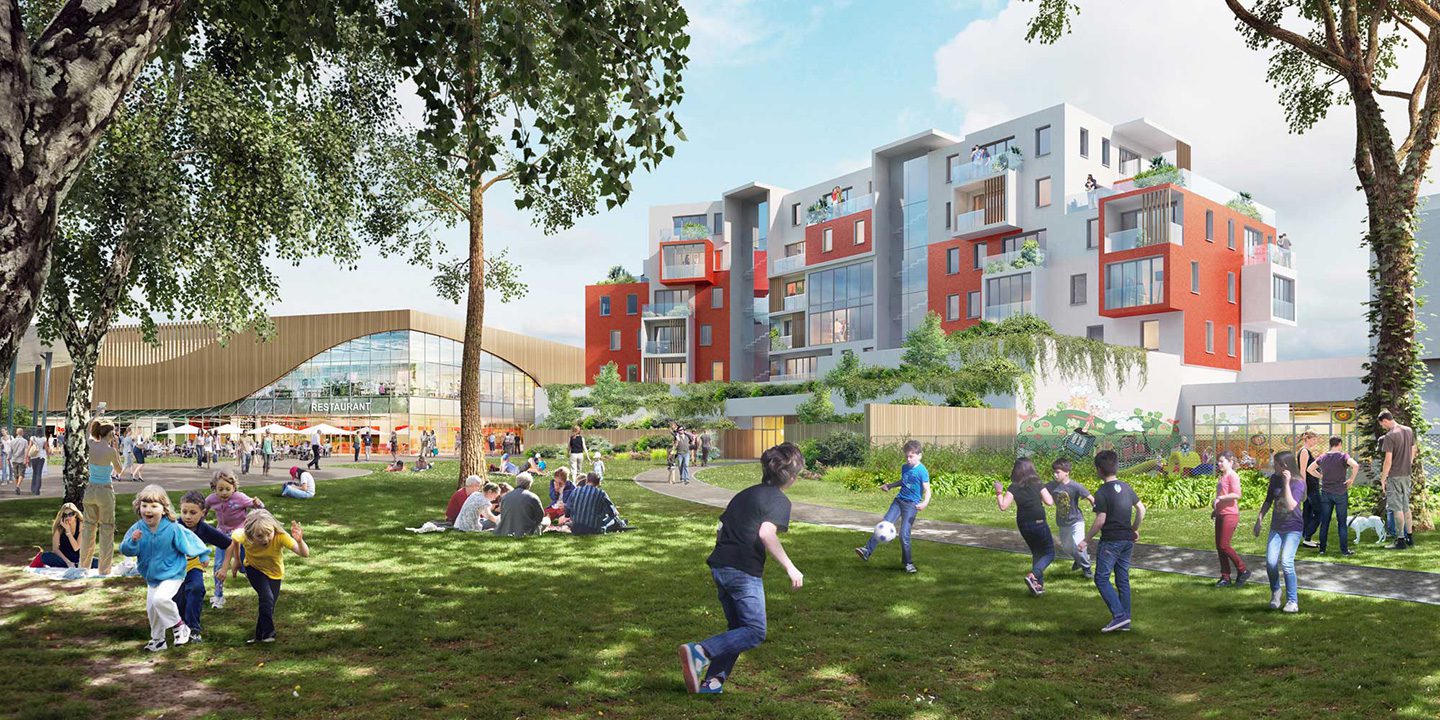
The covered passage we are proposing is the focal point of the architectural system we are putting in place. Its commercial role is of course specific, since it contains medium-sized units and restaurants: the atmosphere that will inhabit this space follows from this role, and it is decisive. More than a “passage”, this place becomes a playful destination. The restaurant hub, facing both the park and the interior street, is a pleasant place for encounters and togetherness.
The architecture of the passage is unprecedented in downtown Dunkirk: the goal is to create a “landmark” building, naturally positioned between Pôle Marine and Centre Marine. We have chosen a timber structure, large spans, light wooden cladding, and very wide openings to light, which is particularly necessary since the façade facing the park is oriented to the North. The lines of this building are pure: a large parallelepiped, whose exterior simplicity is highlighted by generous curved lines separating cladding and glass.
Along the park, a protective glass canopy shelters the restaurant terraces.
The interior architecture contrasts with the calm emanating from the façade treatment: enhancing the existing rotunda allows for a false staff ceiling that plays with curves and counter-curves to create a white and spectacular interior space.
Offer a sheltered promenade.
Between the shops located on the ground floor and the superstructures of the residential buildings, a light glass canopy runs along, protecting walkers from the rain. It is the counterpart of the concrete canopies on Rue Jean Bart, after crossing Centre Marine.
Commercial offer.
The pedestrian structure of the project consists, as developed in the specifications, in reinforcing the existing shopping loops in the city center, and offering a high-quality commercial link between Pôle Marine and Centre Marine. As an option, we propose to punctuate these promenades with small kiosks, creating good commercial support for pedestrians, particularly along the main axis.
Favour a light structural construction method.
As indicated, the covered passage is a timber building. The idea of proposing an entirely timber construction for the residential buildings, using CLT (Cross Laminated Timber) techniques, is of course suggested, but can only be developed with the full agreement of all parties.
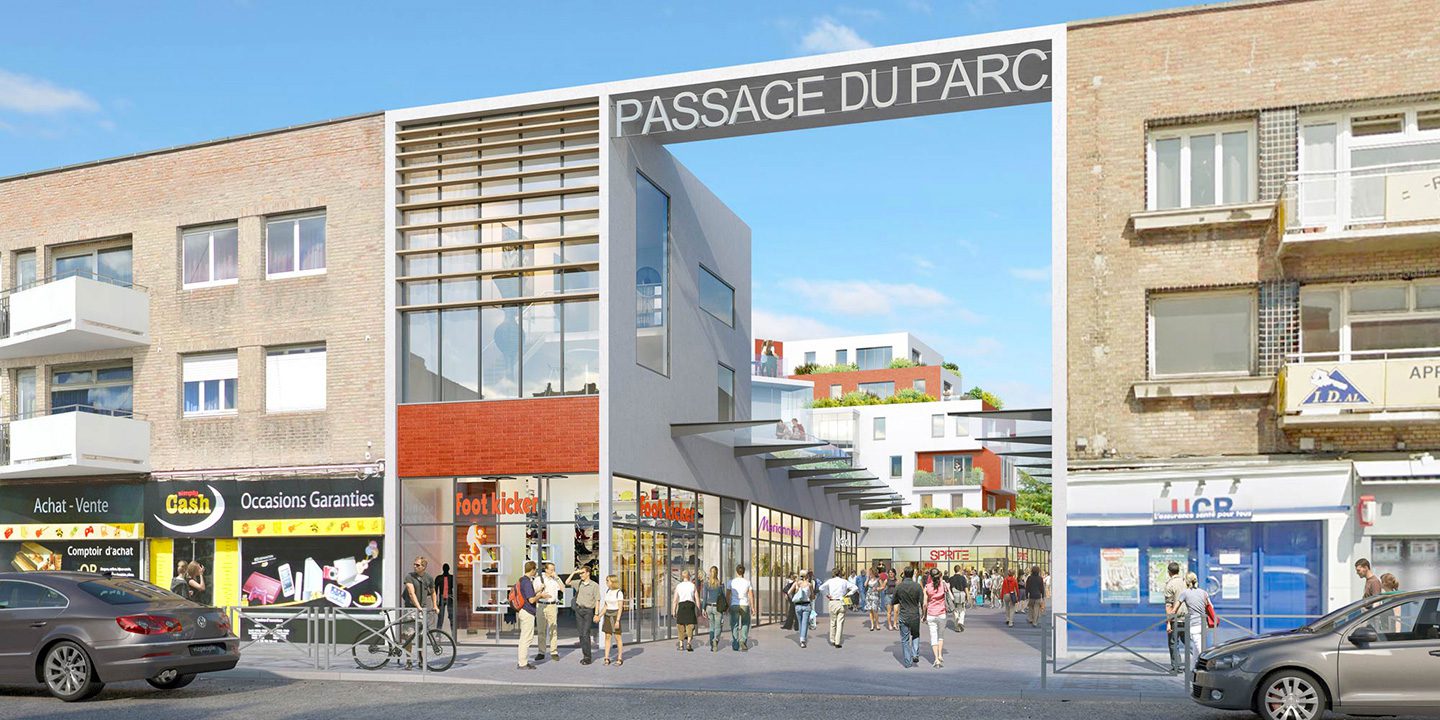
Create a qualitative link between Parc de la Marine and Boulevard Alexandre III.
The layout plan highlights a large opening from Boulevard Alexandre III toward Parc de la Marine. We respected this configuration, and wanted to give the park entrance and the new neighbourhood symbolic clarity: a tall portal frames the view toward the park, while shops are placed on both sides of the walkway to invite passers-by into the commercial street.
On the Rue des Fusiliers Marins side.
A portal of the same “architectural family” is developed on Rue des Fusiliers Marins. The specific difficulty of this entrance is the crossing through the historic building of the Maritime Affairs. We align the canopy with the upper band of the existing building, reproducing the rhythm and truncated-cone shape of the existing columns. It seems to us that these provisions comply with the position of the Architectes des Bâtiments de France and remain of course open to discussion.
Architecture of the housing.
The residential buildings are designed based on the generic concept of the “loggia”. Dunkirk, a port city, benefits from remarkable light quality. At the same time, the wind is very present and sometimes reinforces the sensation of cold. This is why we wanted to develop in the proposed buildings the concept of intermediate spaces between inside and outside. The idea is to transform balconies by giving them enough depth to be considered as winter gardens: like boxes hanging from the façade, they punctuate it, giving it its specific character and volumetric originality. They have a double glazed screening system, enabling a greenhouse effect, particularly useful on windward façades.
It also allows for very large glazed façades, similar to urban buildings in the region.